
UNICOIL 2026 Symposium
Following on from the birth of UNICOIL at the University of Leeds in April 2025, the inaugural symposium to be convened under the banner of UNICOIL was held on 23 April 2026 at Sheffield Hallam University.
This hybrid event was attended by almost 70 colleagues with diverse expertise (professional services, academics, researchers and sector leaders) from 25 universities across the UK and Ireland and 8 from further afield. Read on for an overview of the symposium.
Symposium Keynote
At this year's Symposium we gathered with a sense of urgency, conscious of the vital importance of scaling up our provision of inclusive global study opportunities. Nowhere did this message come through more clearly than through the keynote delivered by Larisa Schelkin. Larisa is an educator and researcher specialising in internationalisation, science diplomacy, and collaborative online learning. She teaches in the United Nations Institute for Training and Research (UNITAR) Global Diplomacy Fellowship Programme, and also works with NASA GLOBE, supporting international STEM education and collaborative learning initiatives with partners in 127 countries.
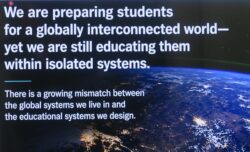
Larisa's keynote emphasised a lingering disconnect seen between education systems and how the world actually undertakes work.
Take a deep dive into the keynote speech here: UNICOIL 2026 Symposium-keynote slides L.Schelkin

Pecha Kucha - Institutional Leadership and Support for COIL
The Symposium also featured a Pecha Kucha session:
The COIL value proposition for Universities – John Joe O'Farrell (Atlantic Technological University, IE)
The COIL value proposition for Students – Dr Anthony Manning (Arden University, UK)
The COIL value proposition for Employers - Dr Izzy Crawford (Robert Gordon University, UK)
The COIL value proposition for Staff - Dr Stephanie Doscher (Senior Fellow with Global Citizenship Alliance and Executive Board member of COIL Connect)

Dr Anthony Manning (Associate Dean International at Arden University) is an experienced leader in international education. Prior to joining Arden, Anthony held senior roles at the University of Kent and the University of Reading. Anthony has lived and worked in five different countries and is also a trustee for the British Accreditation Council and an expert committee member for EAIE, NCUK and the British Council.
The COIL value proposition for Students
- COIL enables students to gain meaningful international learning experiences without the need for travel, removing common barriers associated with mobility (typically has only 1-3% student participation), including financial limitations, visa restrictions, and personal circumstances. It makes global learning more inclusive and accessible, particularly for widening participation students.
- COIL helps develop students’ intercultural competence and global mindsets, helping them build the ability to communicate and collaborate effectively across cultures through structured interaction with international peers. Cultural Intelligence (CQ), exposure to diverse perspectives, and the cultivation of applied global competence are key graduate attributes which cannot all be serviced via Study Abroad alone.
- COIL supports enhanced student employability and future-focused skills required in an increasingly international and digitally connected workplace. It develops transferable skills such as communication, adaptability, teamwork, digital collaboration, and problem-solving within diverse teams. COIL simulates contemporary global working environments where collaboration across borders and time zones is common.
- COIL helps create authentic and engaging learning experiences, moving learning beyond abstract classroom discussion by immersing students in collaborative, problem-based activities linked to real-world global challenges, such as the UN Sustainable Development Goals. COIL helps to increase student engagement, motivation, and meaningful participation through authentic international collaboration.
- COIL fosters personal transformation, identity development, and belonging, increases students’ confidence in communicating across cultural difference, reduce anxiety associated with international interaction, and strengthens their sense of themselves as global learners. It also helps students develop a stronger sense of global citizenship and participation within an interconnected international community.In sum, COIL is a progressive student value proposition that moves from widening access to global experiences, through the development of intercultural competence and employability skills, towards authentic learning and ultimately personal transformation and global identity formation.
 Dr Izzy Crawford is a Co-Lead of the UArctic Thematic Network for Collaborative Online International Learning and Biodiversity Education and Associate Dean for Economic, Social, and Cultural Development at Aberdeen Business School, Robert Gordon University, where she has worked for over 20 years. Izzy is an Accredited Member and Fellow of the Chartered Institute of Public Relations and a Fellow of the Higher Education Academy. Her PhD considers different stakeholder perspectives of Collaborative Online International Learning (COIL) as a flexible learning approach.
The COIL value proposition for Employers
- The global workplace is unpredictable, dynamic and volatile - politically, economically, sociologically, technologically, legally and environmentally. Conventional pedagogy which focuses on academic excellence is not enough to address these complex human challenges.
- To succeed in the global, digital workplace, now and in the future, employers need graduates who can demonstrate academic, social, and emotional intelligence and skills, across disciplines, cultures and time zones.
- The DYNAMITE (Crawford, 2024) model identifies the specific traits and skills that COIL can help to develop in students before they enter workplace. These include digital literacy, intercultural sensitivity and competence, interpersonal communication and leadership skills, team work, reflexivity, resilience, adaptability, empathy, problem solving and creativity.
- COIL projects that address real world problems can enable students to navigate challenges from different global and disciplinary perspectives in a safe environment. By working collaboratively online they co-produce the solutions, and develop the transferable skills, that employers need.
- COIL projects that encourage students to reflect on, identify, and articulate the knowledge and skills they have developed through participation, can be beneficial for CV and interview preparation, as well as career progression.

Dr Stephanie Doscher, Ed.D., is an internationally recognized scholar-practitioner and senior leader in higher education internationalization and serves as Senior Fellow with the Global Citizenship Alliance and as Executive Board member of COIL Connect. Stephanie co-authored The Guide to COIL Virtual Exchange (2022) and Making Global Learning Universal: Promoting Inclusion and Success for All Students (2018) and hosted the Making Global Learning Universal Podcast.
The COIL Value Proposition for Staff: The role of the COIL Coordinator is one of the newest and most powerful and emergent professional roles in international higher education.
- Like Mary Poppins’ bottomless bag of tricks, COIL Coordinators have competencies in international relations, educational development, and educational technology to fulfil their key functions of recruiting, matching, training, and sustaining COIL partnerships.
- Much like a circus ringmaster, Coordinators assemble an assortment of people to work together across disciplines, departments, and reporting lines on the common COIL project.
- COIL can be a scary and bumpy ride for partners, so it’s critical that Coordinators help faculty connect deeply to why they want to COIL, not just what they will do with their students.
- To enable faculty to become practitioners, COIL professional development should involve the same attributes as a strong COIL exchange: it should be partnered, experiential, and goal oriented.
- The most valuable aspect of COIL may not be the COIL itself, but in the many ripple effects that it can lead to, the additional international teaching, learning, research, service, and career development opportunities that are so valuable for faculty, students, institutions, and communities.

John Joe O'Farrell is an international education and management professional with nearly 20 years of experience in both the private and public tertiary education sector in Ireland. Director of International Engagement at Atlantic Technological University he promotes and champions mobility initiatives, including COIL. John Joe recently joined Universita Cattolica del Sacro Cuore in Italy, as a prospective PhD student. His research is investigating the Cultural Readiness for COIL (a form of virtual education exchange) in Irish Technological Universities and U.S Community Colleges.
The COIL value proposition for Universities
- For a long time, internationalisation was almost synonymous with physical mobility; study abroad, exchange numbers, flights taken. But only a small proportion of students ever access those experiences, for a variety of well documented reasons. How do we ensure all students develop global and intercultural competencies — not just the mobile few? This is the challenge COIL directly responds to.
- From Stakeholders to Systems: Building Sustainable COIL Infrastructure;
Moving from identifying who (multiple stakeholders) are involved to understanding how COIL works as a system within an institution. Despite some motivated coordinators and keen faculty, COIL has failed to scale – we need to ask ourselves why? Because it’s not just about people, it’s about institutional alignment, structure, infrastructure, and strategy with shared and measurable KPIs. Communities of practice like UNICOIL can also help. - Transitioning from fragmented approaches towards a more cohesive and vertically integrated model of Global Learning across undergraduate education is essential. This involves creating a developmental continuum that progressively supports students’ growth towards global citizenship, with embedded COIL positioned as a strategic priority for the university. The model incrementally builds students’ global awareness, intercultural competence, and collaborative capacity throughout their studies: beginning with awareness-building and foundational global perspectives in Year 1; structured exposure to COIL and virtual intercultural collaboration in Year 2; opportunities for optional physical mobility and international engagement in Year 3; and culminating in critical reflection, professional application, and global citizenship practice in Year 4.
- One of COIL’s strengths is that it doesn’t sit in just one strategic box, rather it intersects with other university priorities such as, Teaching and Learning (curriculum innovation), Graduate attributes and employability (global collaboration and digital teamwork), EDI (widening access), Digital transformation (using platforms for meaningful global learning) and Sustainability (reducing carbon-intensive mobility). COIL becomes a connective tissue across university priorities, rather than a siloed initiative.
- From an institutional perspective, COIL’s value proposition is compelling. It’s: Scalable, cost-effective, inclusive, and resilient. COIL also acts as a low‑risk way to build and test international partnerships, often leading to deeper collaboration in research or mobility later on. In this sense, COIL doesn’t replace traditional internationalisation - it strengthens and future‑proofs it. It isn’t just a pedagogical model - it’s a strategic choice about the kind of global university we want to become. Ultimately, COIL challenges us to reflect on the purpose of internationalisation.
UUKi at UNICOIL: Creating Inclusive Global Student Mobilities

The first part of the afternoon plenary featured a talk from Franziska Enichlmayr, Policy Officer (Europe) at UUKi, where she leads UUK's engagement with the European University Association (EUA) and focuses on EU policy and bilateral engagement. She supports and develops opportunities to strengthen UK universities’ collaboration in Europe and works across a range of European policy programmes, including Horizon Europe and Erasmus+.
UUKi at UNICOIL Creating Inclusive Global Student Mobilities- F. Enichlmayr (downloads slides)
As a membership body representing 141 UK universities, Universities UK International (UUKi) supports UK institutions in maximising international experiences for UK-based students. UUKi champions Internationalisation at Home (IaH), publishing a practical IaH handbook to help embed global perspectives across curricula. In recent years, Collaborative Online International Learning (COIL) has grown, demonstrating how digital collaboration can reach new audiences and provide valuable international learning experiences. While COIL and Blended Intensive Programmes (BIPs) do not share identical objectives, COIL can serve as a stepping stone or exploratory pathway for institutions considering more immersive formats like BIPs. With the UK’s association to Erasmus+, BIPs (part of KA1 in Erasmus+) are gaining momentum, and UUKi is helping universities navigate and maximise these opportunities. Through policy advocacy, sector guidance, and practical resources, UUKi empowers institutions to make international engagement more innovative, inclusive, and impactful for all students. This session will connect the sector on COILs, explore their potential links to BIPs in practice, and highlight UUKi’s priorities around Outbound Student Mobility (OSM).
Leveraging strategic connections between COIL, TNE and student exchange
The second part of the afternoon plenary featured a talk from Prof. Martin Ward on the underexplored potential for institutions to leverage connections between transnational education (TNE), student exchange (mobility) arrangements to expand their offer of COIL.
Leveraging strategic connections between COIL, TNE and student exchange (opens slides)
COIL research posters
The symposium featured a number of research-based posters about aspects of COIL from various universities. The poster sessions created a dynamic space for discussing ways to embed and critically evaluate the impact of COIL. A number of these posters are included here with permission of the researchers. You can click 'show all' to display the full gallery.